Loose Parts as a Hands-On Language
What are Loose Parts?
Loose Parts are open-ended materials that can be used in multiple ways. Think buttons, screws, corks, rocks, glass gems, leaves, sticks, etc. A quick Google search will bring up many resources that both define and justify using Loose Parts in learning encounters.
As a middle school teacher and adult learning facilitator, I’ve found that loose parts provide a tangible way for students to explore and (re)present abstract concepts. It’s like giving them a hands-on language for thinking!
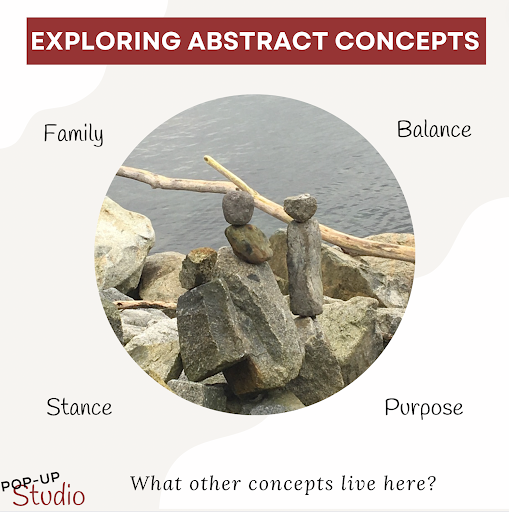
What do we mean by hands-on language?
Have you heard of Reggio Emilia educators speaking of the 100 languages? Loris Malaguzzi valued the role expressive arts can play in learning, recognizing that each material has its own grammar or language. Becoming proficient in speaking that language helps artists explore and (re)present the world in nuanced and emotive ways. While I haven’t always perceived art materials, or any pliable material, as a language, I have come to appreciate the role materials play in shaping us as we shape them (Pacini-Ketchabaw et. al, 2017).
If you are an academic, you might enjoy a Google Scholar search into “Thing Theory” or “New Materialism” for discourse around things and theorizing.
Play Notice + Wonder with Me
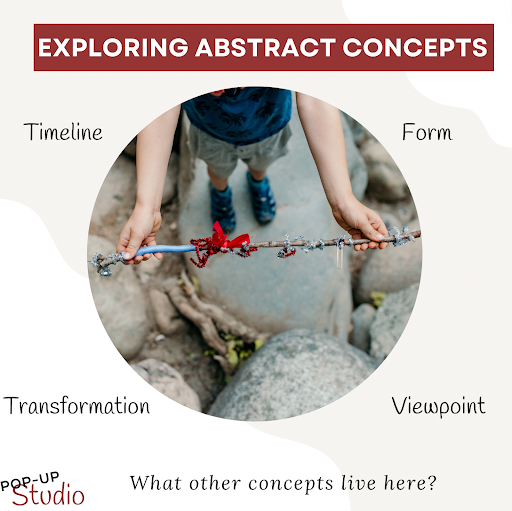
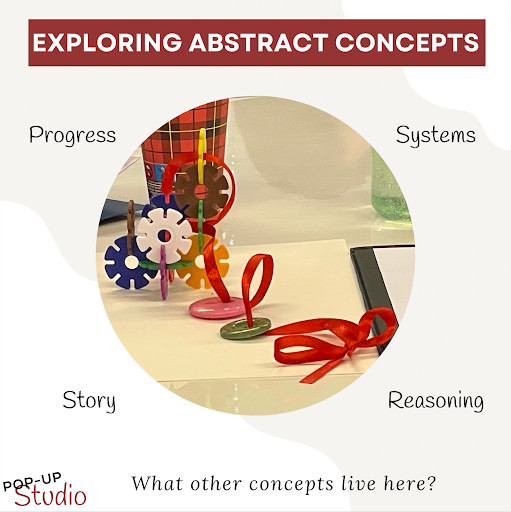
Take a look at the images (student samples) in this post, and consider:
- How do these loose parts express the abstract concepts suggested?
- What other concepts do you see in these samples?
- Which loose parts might you use in YOUR context to explore the concepts in your curriculum?
Want to learn more about materials and inquiry?
One of my favourite books to explore the role of materials in learning is:
Pacini-Ketchabaw, V., Kind, S., & Kocher, L. (2017). Encounters with materials in early childhood education. New York, NY: Routledge.
While the work is rooted in Early Years, I have found that the ideas are applicable in contexts where complex and relational thinking are valued.
coming soon

Bring creativity, connection, and joy to the books you read together. My free Hosting Kit turns professional reading into a fun, participatory experience—inviting colleagues to play with ideas, make meaningful connections, and put new thinking into practice.
