Teaching Is Better in Company
What becomes possible when Collective Care and instructional practice come together?
Not long ago, I ran into a principal colleague, Scott, whom I had worked alongside for many years. We were on the sidelines of a basketball game at his school. I was watching my son play and he was cheering on his team.
“Misty, what are you doing now?” he asked.
I told him a little about my research with teachers and the Collective I was creating. I did my best to explain how I was bringing together what I had learned about teacher flourishing, successful school climates, creativity, and the instructional practices I have spent my career developing alongside educators. His response was immediate: “Does the British Columbia Teachers’ Federation know about what you’re doing? This is just what we need right now!”
Delighted by his response, I asked him to name the value of my work. With conviction he stated, “You’re bringing together well-being with instructional practice—what you’re offering helps us feel connected, creative, and alive also enlivens the way we teach.

Scott captured the essence of my work in a way I was struggling to, maybe because I’m so close to it: I know the feeling of survival mode in education, when the work narrows to getting through the day, the week, the term. I also know the entirely different feeling of leaving a conversation with a colleague carrying an idea I cannot wait to try; of planning together and suddenly finding ourselves laughing; of seeing a familiar part of the curriculum differently because someone asked a question I would never have thought to ask. And I know the delight of receiving the text from a teacher that says, You have to see what my students did!
Joy moves. When something comes alive for us, we want to share it. This is where my research into teacher flourishing has been leading me: away from treating wellbeing as something we attend to before returning to the “real work” of teaching, and toward considering what becomes possible when we care for the people and the practice together.
From self-care to caring company
Teaching asks a great deal of us. In my doctoral research, I described the work as a kind of tightrope between passion and depletion, shaped not only by the intimate emotional work of being with children and families, but by the conditions in which our work takes place. Chronic under-resourcing, intensifying demands, competing initiatives, political pressures, and the accumulation of emotional labour all enter the classroom with us (Paterson, 2025). When teachers are expected to carry the burdens of teaching without themselves being adequately cared for, hurt blooms.
Of course individual care matters. Therapy, medication, movement, rest, time outdoors, extended health benefits, a good meal, or an evening doing something entirely unrelated to education can all contribute to our wellbeing. I am grateful for many of these things in my own life. My concern is what happens when the wellbeing of teachers becomes primarily the responsibility of individual teachers. Drawing on Pooja Lakshmin’s (2023) work on Real Self-Care, I explored this tension in my dissertation: individual practices can be beneficial, but they cannot on their own change the relational and systemic conditions in which a person is being asked to work (Paterson, 2026). I have no interest in flourishing becoming one more competency teachers are expected to master, as though the goal were to become increasingly capable of withstanding whatever comes our way.
What interested me instead was what happened when teachers were given time, space, materials, and one another. Nine teachers participated in the creative co-inquiry at the centre of my doctoral research. We made things together. We talked and listened. We worked with humble materials and reflected on experiences that were sometimes difficult to articulate in words alone. There was vulnerability, but there was also humour, curiosity, beauty, surprise, and the peculiar pleasure of discovering something through making that you did not quite know before you made it.
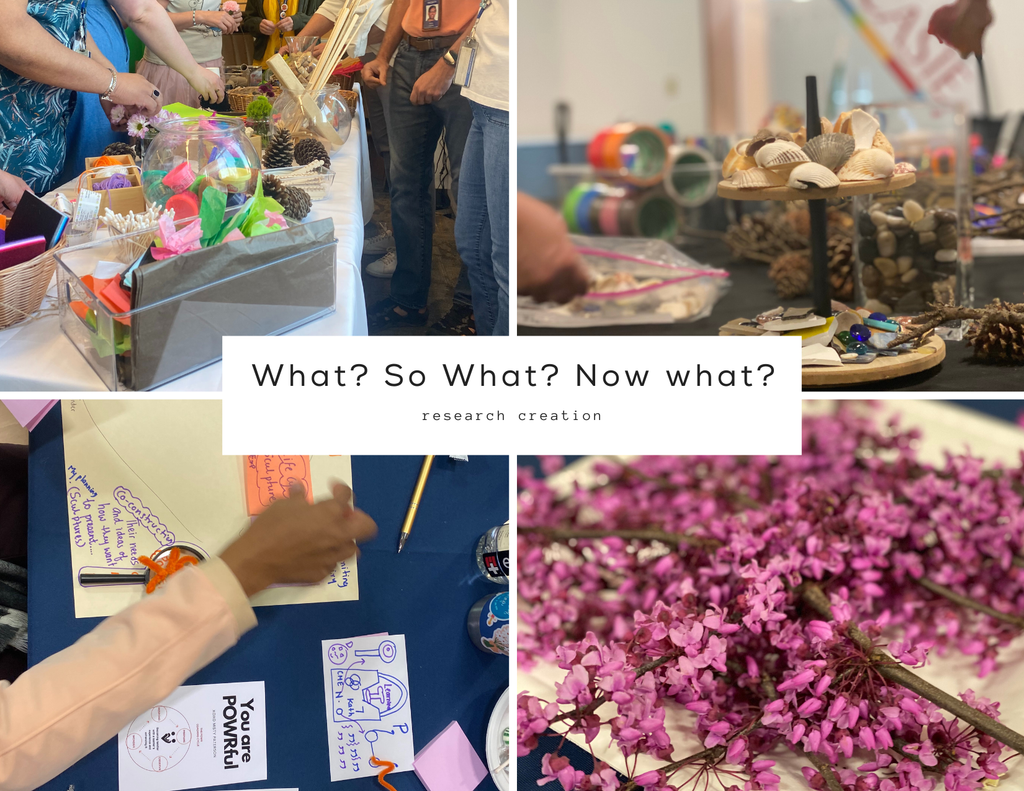
I came to call this creating in caring company. Bracha Ettinger’s (2006) concept of carriance helped me understand something we experienced in those gatherings: the possibility of carrying and being carried in shared encounter. This was not about fixing one another, absorbing one another’s distress, or pretending that collegiality could resolve structural problems. It was about the trust and collective efficacy that’s generated between teachers when we do not have to experience the complexities of our work alone.
The teachers in my study helped me see care less as something one person provides for another and more as something that can be created between and among us. Intentional creative spaces opened possibilities for the very affects successful schools need to flourish (Paterson, 2025) which, for me, fit under the umbrella of Collective Care.
Finding Collective Care elsewhere
I didn’t begin the doctorate with the conceptual lens of collective care and then design a study around it. I came to know care differently through the inquiry itself. And know I’m even more curious about the relationship between care, creativity, and collective wellbeing. And it turns out that I’m not the only one talking about this trifecta.
While researching a SSHRC proposal for prospective postdoctoral work with Professor Claudia Mitchell at McGill University, I encountered a striking resonance in the work of the United Nations Secretary-General’s High-Level Panel on the Teaching Profession. The Panel (2024) calls for a “whole-of-society approach” to transforming teaching and argues that educators should work within a climate of security, support, wellbeing, and decent working conditions. I remember the feeling of recognition. Here was something I had arrived at through the intimate scale of a small group of teachers gathered around tables in British Columbia meeting a much larger international conversation about the conditions necessary for teachers and education to flourish. The SSHRC grant was not funded, but the inquiry did not disappear with the application. I am living it in my daily work with teachers.
Knowledge mobilization asks us to bring what we learn back into relationship with the communities from which that knowledge grew, where it can be questioned, extended, and made useful. The teachers who participated in my research offered calls to action, including opportunities for educators to create, connect, and explore the emotional complexities of teaching together. They recommended integrating Art-Care into existing gatherings not as another demand, but as an opportunity to build community (Paterson, 2025). Those calls to action are being explicitly woven through all of my service offerings: coaching, project residencies, and the Flourishing Teachers Collective. As this work unfolds, I am consistently reminded that caring for teachers and caring for instructional practice are not separate conversations.
When teaching comes alive
At this point, you might be asking, “Misty, what does your work actually look like?“. Imagine a teacher brings a question about her students into a gathering. The question resonates with another teacher who offers a connection. We invite materials to think with us about this resonance, the concepts within the connection, or the emotions that sit underneath. Engaging in process artmaking, we invite a thinking beyond words. We aren’t creating a fixed image or representation of the concept, but rather moving with the materials in a shared inquiry. Then we gather to share the insights, questions, connections, and resonances that surfaced. And we leave with greater insight than we arrived with. And usually, that insight appears in a classroom with learners and is offered through another encounter. The students take the offering somewhere the teacher hadn’t anticipated, and she sends a photograph or a message to me or to someone in the group because she wants to share the experience. This movements build a culture of collective care.
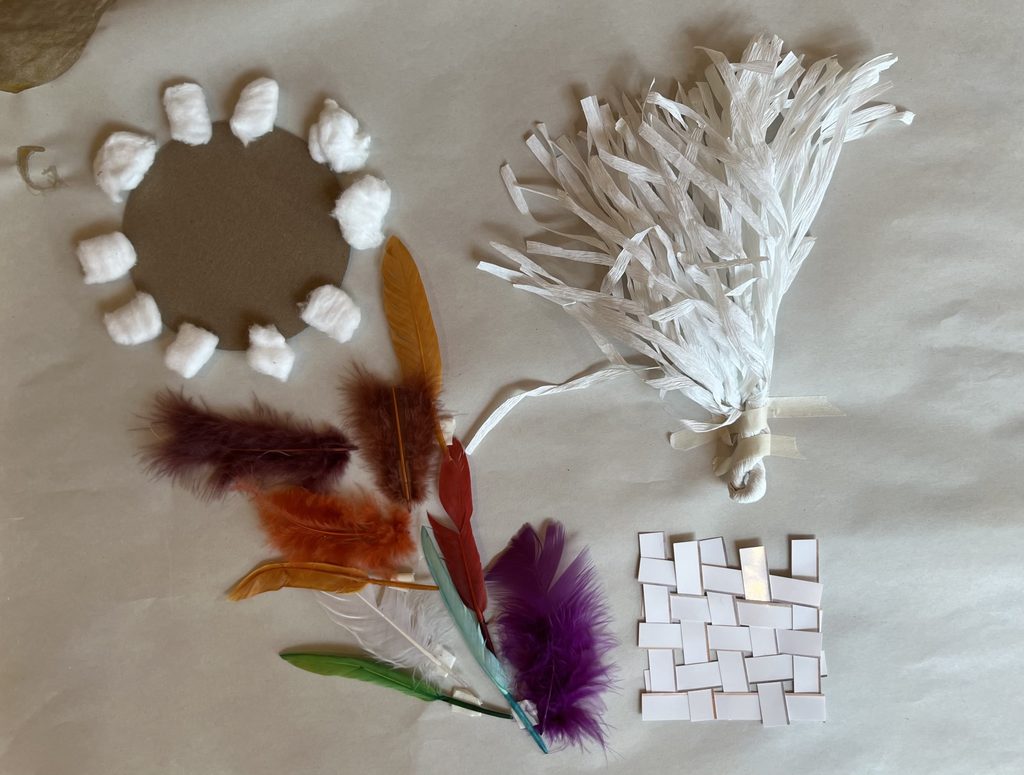
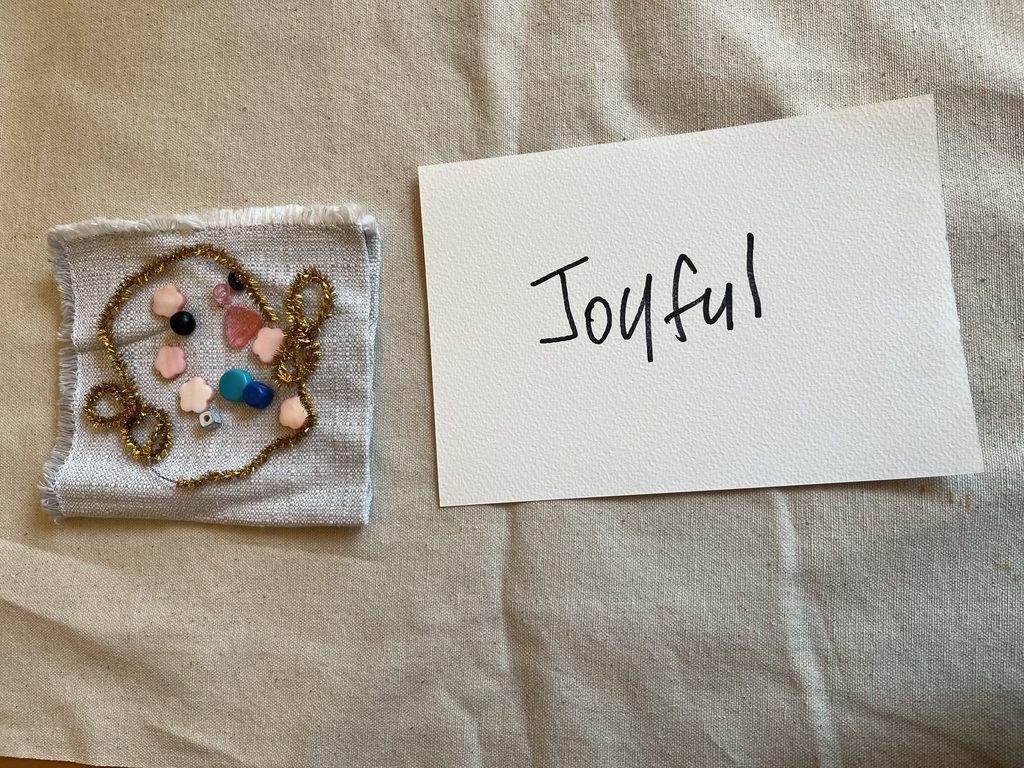
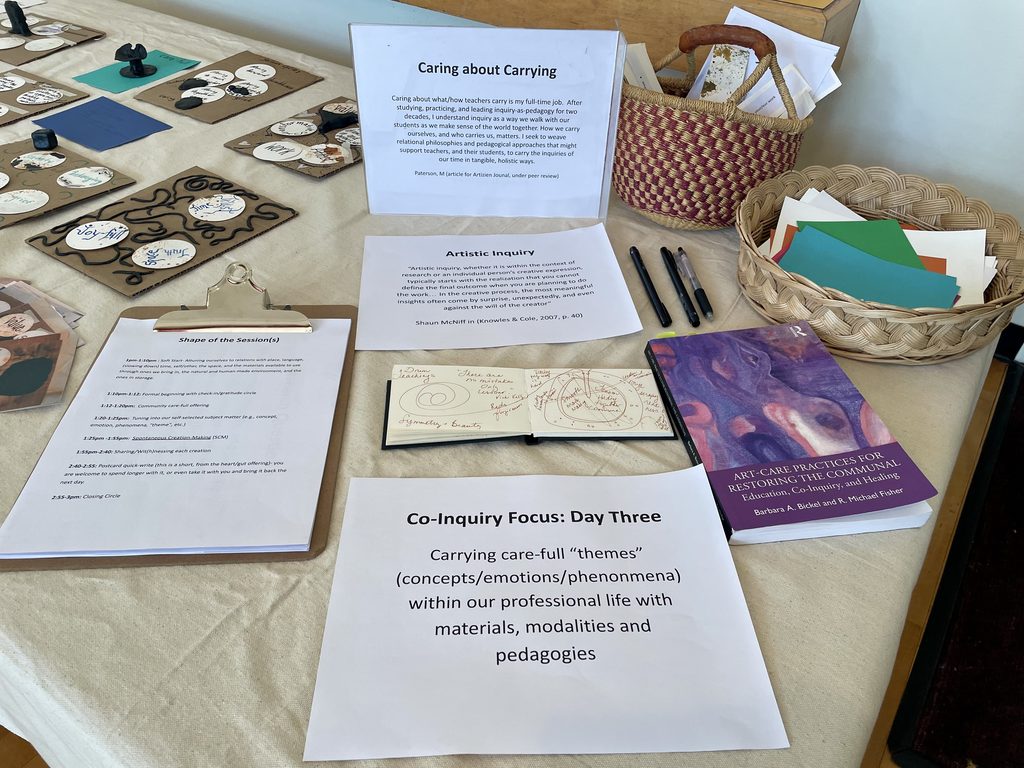
Between three degrees, and over twenty-five years of experience, I’ve learned that our teaching practices can be a source of vitality. You know what I mean: A question sparks our curiosity. Making something shifts our thinking. Understanding a learner differently renews trust. A colleague helps us rediscover possibility in a part of our practice that had become routine.
The creative experiences I speak of in this post don’t ignore the realities of inadequate resources, excessive workload, inequity, or the other pressures shaping teachers’ lives. Collective Care cannot be used as a pleasant substitute for the material and systemic conditions educators need to do their work well. Indeed, the UN High-Level Panel (2024) situates teacher wellbeing alongside decent working conditions, professional support, and wider social investment in education. But I also don’t want our conversations about teaching to become so saturated by survival that we lose sight of what we are trying to make possible.
I want teachers to experience the magic of engaged students. I want us to have colleagues with whom we can get excited about an idea. I want there to be room for the text that says, LOOK WHAT HAPPENED! I want us to experience ourselves not only as people managing an increasingly demanding profession, but as curious, creative, intellectual human beings doing work that can still surprise us. Perhaps wellbeing is not always something we have to leave teaching to find. Perhaps some of it can be cultivated within a teaching life worth living.
The serious business of having fun together
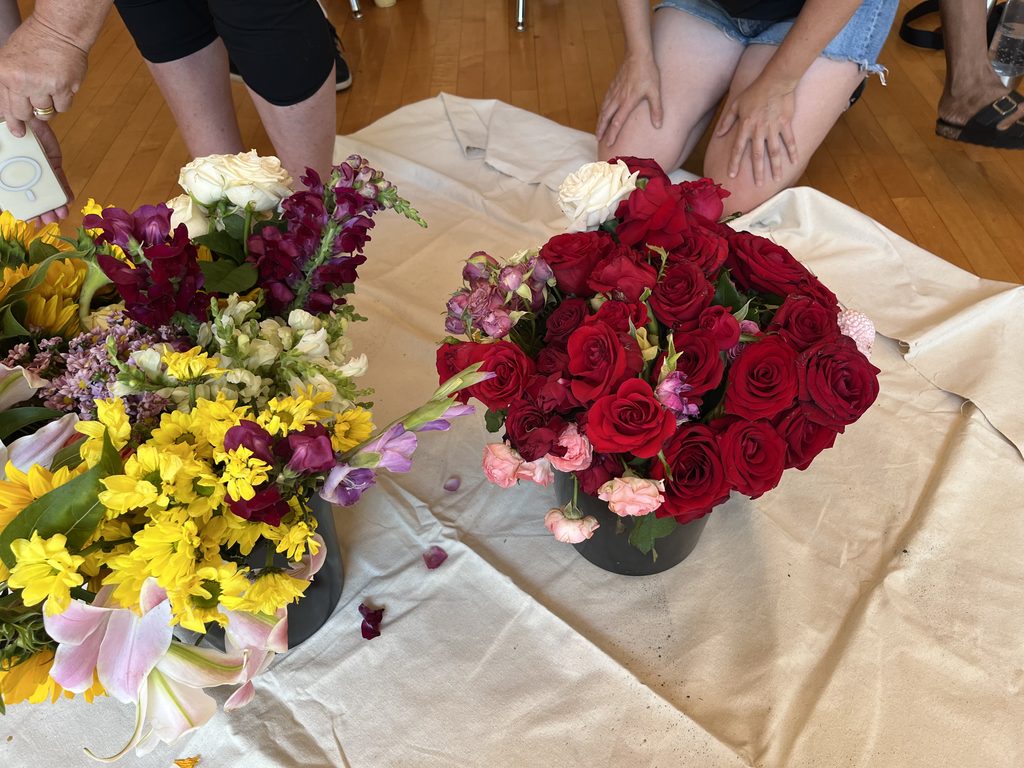
There is another part of Collective Care that I want to take seriously precisely because it can look so unserious: getting together. In the years since COVID disrupted so many of our ordinary habits of gathering, I have found myself increasingly attentive to what happens when teachers are simply in one another’s company—not necessarily for another meeting or formal professional learning session, but to eat, talk, read something interesting, make something, laugh, or follow an idea because it has caught our attention.
I don’t want to instrumentalize those experiences by claiming that every dinner with teacher friends needs to improve instruction or increase collective efficacy. Sometimes a group of tired teachers eating popcorn and laughing together should be allowed to be exactly that. Pleasure, curiosity, beauty, companionship, creativity, silliness, and play are not frivolous additions to a serious professional life. They are part of being fully alive within one.
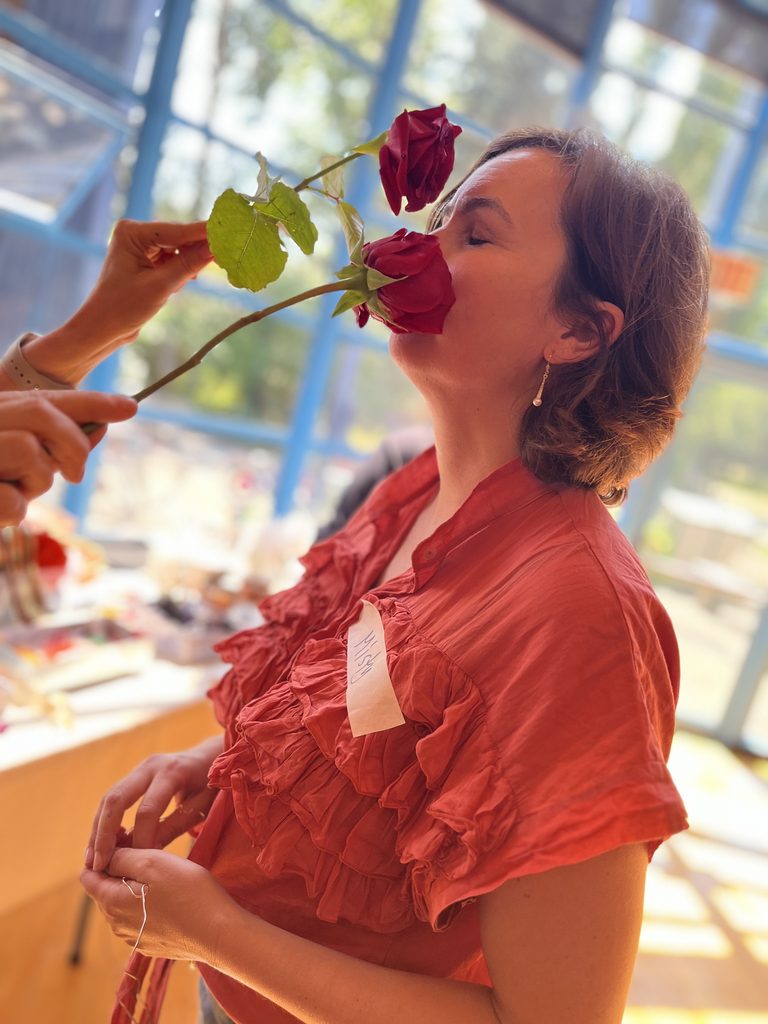
And sometimes, amid all that ordinary being together, something pedagogical happens. Someone mentions a book or tells a classroom story. Someone asks a question and another person says, “That makes me think of…” An idea passes between us and changes as it goes. We leave carrying something we didn’t arrive with. That is another reason I keep returning to Ettinger’s (2006) idea of carriance. What we carry for one another need not always be heavy. We can carry possibility too.
What can we afford?
I’ve been thinking about affordance throughout this first collection of Journal pieces. Gibson (1977) used the term to describe possibilities for action that emerge in relationship between an environment and the one encountering it. In What Can a Material Make Possible?, I ask what different materials afford learners. Here I find myself wondering what our professional lives afford us.
Do the ways we organize teaching afford time to think with other teachers, become fascinated by an idea together, make something, linger, laugh, or know one another beyond our roles and responsibilities? Or does our time together become another place where we efficiently work our way through everything that needs to be done?
There is also the ordinary meaning of afford. What can teachers actually afford? I don’t want Collective Care to be commodified into another beautiful thing teachers have to purchase. There are retreats, apps, memberships, courses, therapies, and experiences that can genuinely support wellbeing, but caring company cannot depend upon having sufficient disposable income to buy it.
Creative experiences that offer joy, meaning, and genuine connection can happen around a kitchen table, in a classroom after school, at a library, on somebody’s couch, or online with people living thousands of kilometres apart. Yes, there can be specialty foods but there can also be tea and whatever is already in the cupboard. The table matters, but the people around it matter more.
Who is your caring company?
We need people with whom the creative, intellectual, relational, and joyful life of teaching can breathe. People who help us move out of survival mode long enough to remember what fascinates us. People who ask good questions, see possibilities we have stopped seeing, make us laugh, and are the ones we cannot wait to text when something extraordinary happens with our students. With that said, let’s circle back to the basketball court and my colleague saying, “This is just what we need right now.” As we zoom into that word: this, what comes to mind for you? What are the working conditions that allow teachers to do their work well in your context? What resources, professional respect, time, trust, and meaningful structural responses are needed to support teacher wellbeing and student achievement? And who helps you think about these questions, deeply and strategically? Who is your caring company?
Want to continue this inquiry with me?
I created The Reading Social because I wanted to make this kind of gathering a little easier. It is a free hosting kit for bringing a few people together around something worth reading and talking about, with room for food, conversation, curiosity, and wherever the ideas take you. It doesn’t need to become another meeting. The point is to be in good company.

GET THE FREE READING SOCIAL KIT →
References
Ettinger, B. L. (2006). The matrixial borderspace. University of Minnesota Press.
Gibson, J. J. (1977). The theory of affordances. In R. Shaw & J. Bransford (Eds.), Perceiving, acting, and knowing: Toward an ecological psychology (pp. 67–82). Lawrence Erlbaum Associates.
Lakshmin, P. (2023). Real self-care: Crystals, cleanses, and bubble baths not included. Penguin Random House.
Paterson, M. (2026). Making care matter through co-inquiry: The HeART of well-becoming [Doctoral dissertation, Simon Fraser University].
United Nations Secretary-General’s High-Level Panel on the Teaching Profession. (2024). Transforming the teaching profession: Recommendations and summary of deliberations. International Labour Organization.
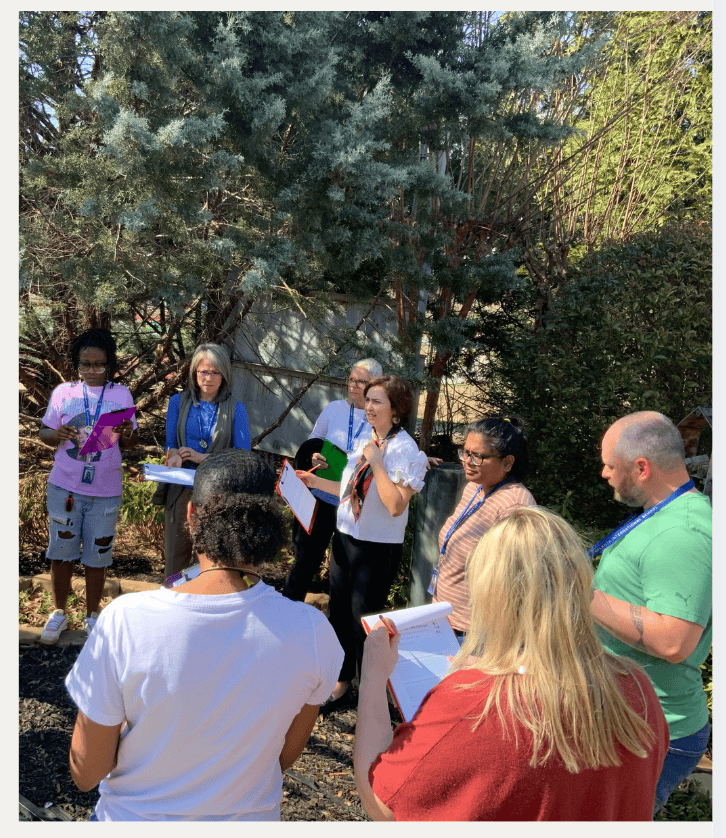

Bring creativity, connection, and joy to the books you read together. My free Hosting Kit turns professional reading into a fun, participatory experience—inviting colleagues to play with ideas, make meaningful connections, and put new thinking into practice.
