What Can a Material Make Possible?
What becomes possible when materials are not simply supplies for learning, but part of how we develop ideas?
I have a soft spot for humble materials: paper clips, corks, string, buttons, cardboard, sticks, wire, scraps of paper, glass gems. For years, I have carried collections like these into classrooms and workshops, arranging them on tables without knowing exactly what they will become. I have a learning intention, of course: I may be interested in a particular concept, question, or curricular relationship. But I have learned not to confuse having a pedagogical intention with knowing what another person should make.
Open-ended materials (see “Loose Parts”) are often associated with early childhood education, and with the Reggio Emilia Approach specifically. Understood as expressive languages, stones, blocks, paper, and other materials used for playful learning and expression each offer their own possibilities—something like a grammar (Orbach, 2006; Pucci 2026) through which ideas can be explored and expressed. Just as young children express and interpret ideas through materials, older children and adults benefit from thinking with materials, too.
Materials beyond Early Childhood
Why should increasingly sophisticated thinking take us further away from matter?
Twenty years ago, while teaching Grade 6/7 through an approach I called Living Inquiry, my students explored broad concepts such as Place, Language, Time, and Self/Other through photography, collage, painting, drawing, sculpture, dance, conversation, and the things they found around them (Paterson, 2010).
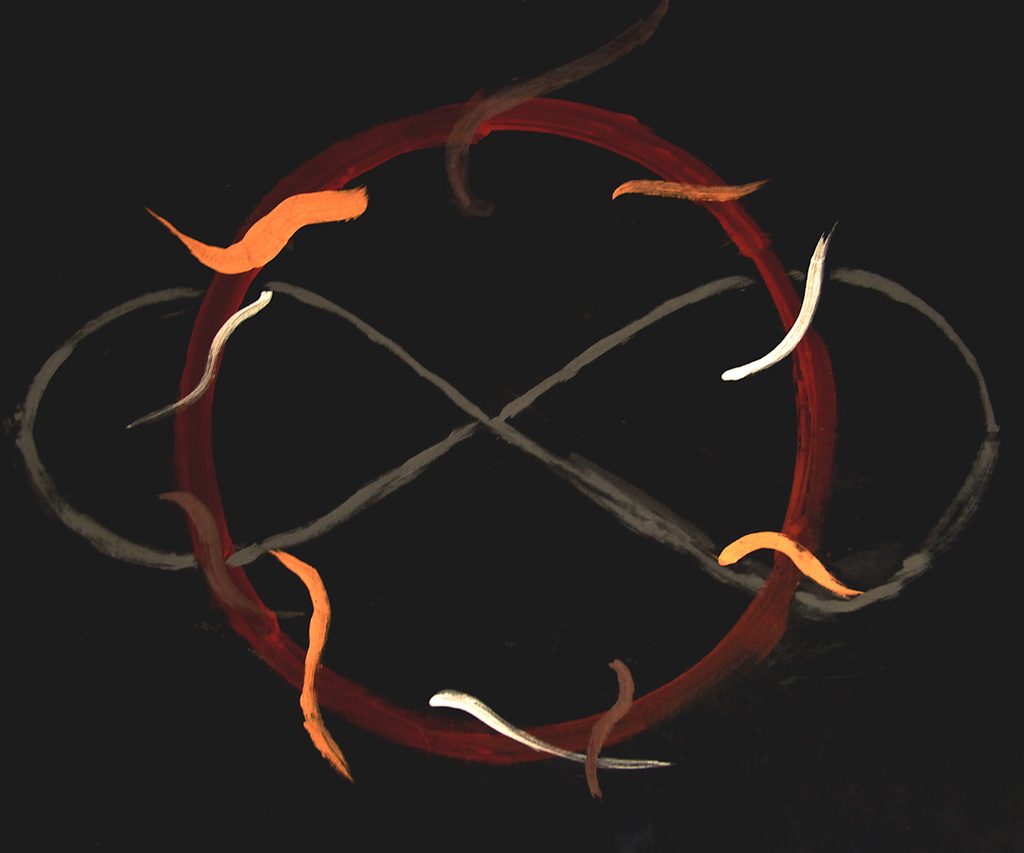
I remember one painting in particular. A group of students had been exploring Time, and their Circle of Life painting became something to gather around and think with. As they talked, they disagreed. They questioned one another’s interpretations and tried to articulate what Time meant and how it operated in their lives (Paterson, 2010). The painting wasn’t simply a way of showing what they already knew. It gave them something to think with.
Materials as a language for thinking
In schools, it can be useful to notice not only which materials are available, but how tightly their purposes have been defined. Some materials are relatively closed or single-purpose. A set of fraction circles, for example, has been designed to make particular mathematical relationships perceptible. There is real value in that precision. But compare a fraction circle to a piece of string, a wooden block, or a sheet of transparent acetate. Their educational purposes are far less settled. I sometimes think of the difference in kitchen terms: a garlic press does one job exceptionally well, while a knife can mince garlic and also slice, chop, crush, carve, score, spread, and perform countless other tasks in response to what the cook encounters. Neither tool is inherently better. They simply afford different ranges of possibility.
The distinction becomes especially interesting when we consider that the openness of a material is not located entirely in the material itself. I have been invited by early childhood principals to work with Montessori-trained educators who wanted to become more flexible in how they perceived children’s uses of materials. In those settings, part of our inquiry was not simply What is this material designed to do? but What else might it be allowed to do? A material may offer many possibilities, but those possibilities can quickly narrow if an adult has already decided what constitutes its proper use. Developing greater flexibility in our own interpretations can therefore create conditions for greater flexibility in children’s thinking.
Recasting your office supplies
This makes me curious about the material life of a school. Where do materials live, who has access to them, when do they appear, and what are learners permitted to do with them? In some classrooms, learning materials are largely understood as manipulatives introduced “as needed”—often when a learner has not yet grasped a concept through more abstract instruction. Making can operate similarly: learners acquire knowledge, formulate an understanding, and then make the poster, model, presentation, or display that demonstrates what they know. Yet years of watching learners make have led me to wonder about the direction of that relationship. What if materials entered earlier? What if making were not simply a means of demonstrating or communicating thought, but participated in the development of thought itself?
James J. Gibson’s (1977) theory of affordances gave me one way of understanding what I was noticing. An affordance describes possibilities for action that emerge in relationship between a living being and an environment. A chair, for example, might afford sitting for a tired adult, climbing for a small child, or reaching for someone trying to retrieve something from a high shelf. The object has not necessarily changed; what becomes possible emerges through the relationship among the object, the person, their capacities and intentions, and the particular circumstances in which they meet. Conversations with Art therapist and Atelierista Roberta Pucchi remind me that each material is a primordial encounter with matter: touch is how we first come to know the world.
Materials in classrooms behave similarly. A piece of string might become a measurement tool, a boundary, a timeline, a connection between two ideas, or part of a construction. A collection of stones might invite one learner to investigate pattern while another uses the same stones to explore balance, hierarchy, community, or belonging. Charcoal, clay, blocks, wire, fabric, and paint offer different movements, resistances, relationships, and possibilities. A material does not arrive with only one possibility inside it. Neither does a learner.
Years ago, I began describing loose parts as a kind of hands-on language for thinking. My encounters with the Reggio Emilia educational project, and its proposition that children make meaning through many languages, profoundly influenced this thinking. Over time, however, I have become less satisfied with the idea that materials simply represent an understanding that already exists somewhere inside the learner.
Materialist scholarship has helped me complicate that assumption. Pacini-Ketchabaw, Kind, and Kocher (2017), for example, invite educators to pay attention to encounters with materials rather than positioning the human as the sole active meaning-maker and matter as passive substance waiting to be used. Anyone who makes things knows something about this experientially. We begin with an idea, but the cardboard bends where we did not expect it to. The tower falls. The charcoal smudges. The wire resists the shape we imagined. Two objects placed beside one another suddenly suggest a relationship we had not considered. We respond, adjust, test, abandon, and begin again.
The thinking has not simply travelled from mind to material. The relationship with the material has changed the thinking.
What if the ideas are power and boundaries?
This becomes particularly interesting with older learners because I am often less concerned with what a material can become than with what it might help us think about.
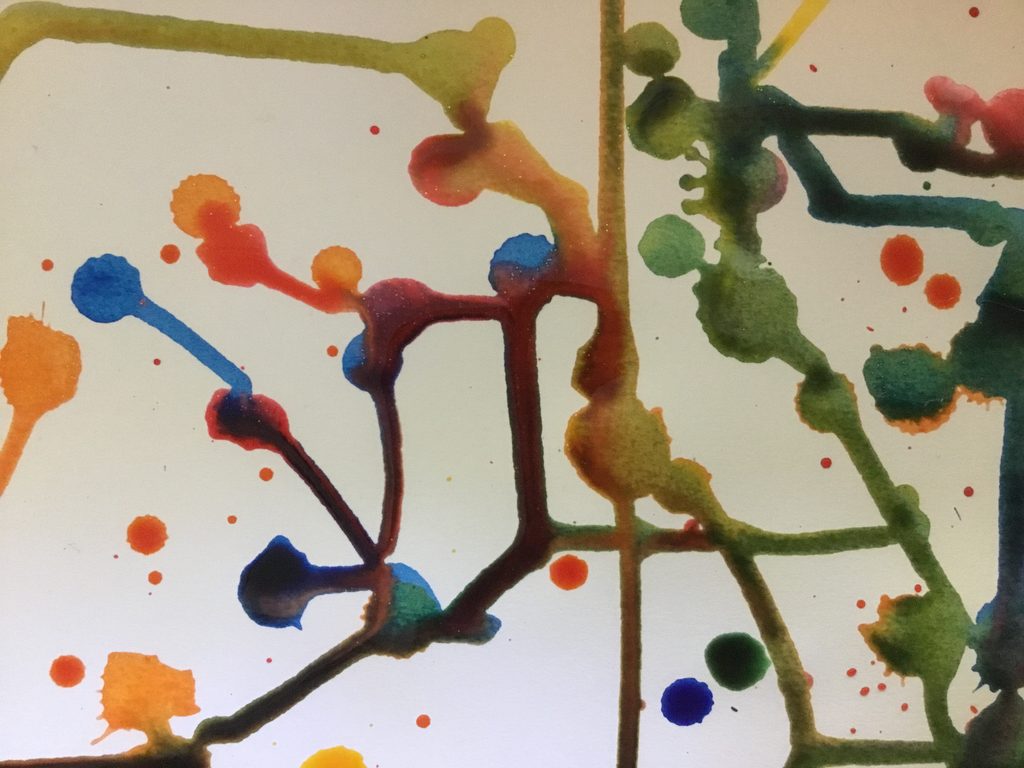
Imagine that a class is investigating the relationship between power and boundaries. I might place an assortment of everyday objects on a table and invite learners to select, arrange, combine, or alter them in ways that help them explore the concept. One learner might choose a heavy stone because power can be difficult to move. Another might choose string because power can connect people, but it can also bind or restrain them. Someone else might place a transparent container over another object and begin considering who is inside, who is outside, and who controls the boundary. Another might explore liquid watercolours.
There is no single correct representation to retrieve. Learners have to perceive a relationship that is not immediately apparent and then make that relationship intelligible to others. The intellectual work deepens when we ask where an analogy holds, where it breaks down, or how an arrangement might need to change to accommodate another perspective. An object can be repositioned. Another can be introduced. A classmate can offer a competing interpretation that makes the first one less certain.
The material is not being used to make a sophisticated idea childish or merely “hands-on.” It is participating in sophisticated conceptual work: interpretation, abstraction, justification, perspective-taking, metaphorical thinking, and revision. In my work with “older” learners, I continue to return to this possibility. Ordinary objects can make abstract ideas temporarily tangible enough to position, defend, challenge, rearrange, and reconsider. This same premise sits underneath my Thinking Through Analogy work with middle-years learners.
Play Matchmaker with Materials and Ideas
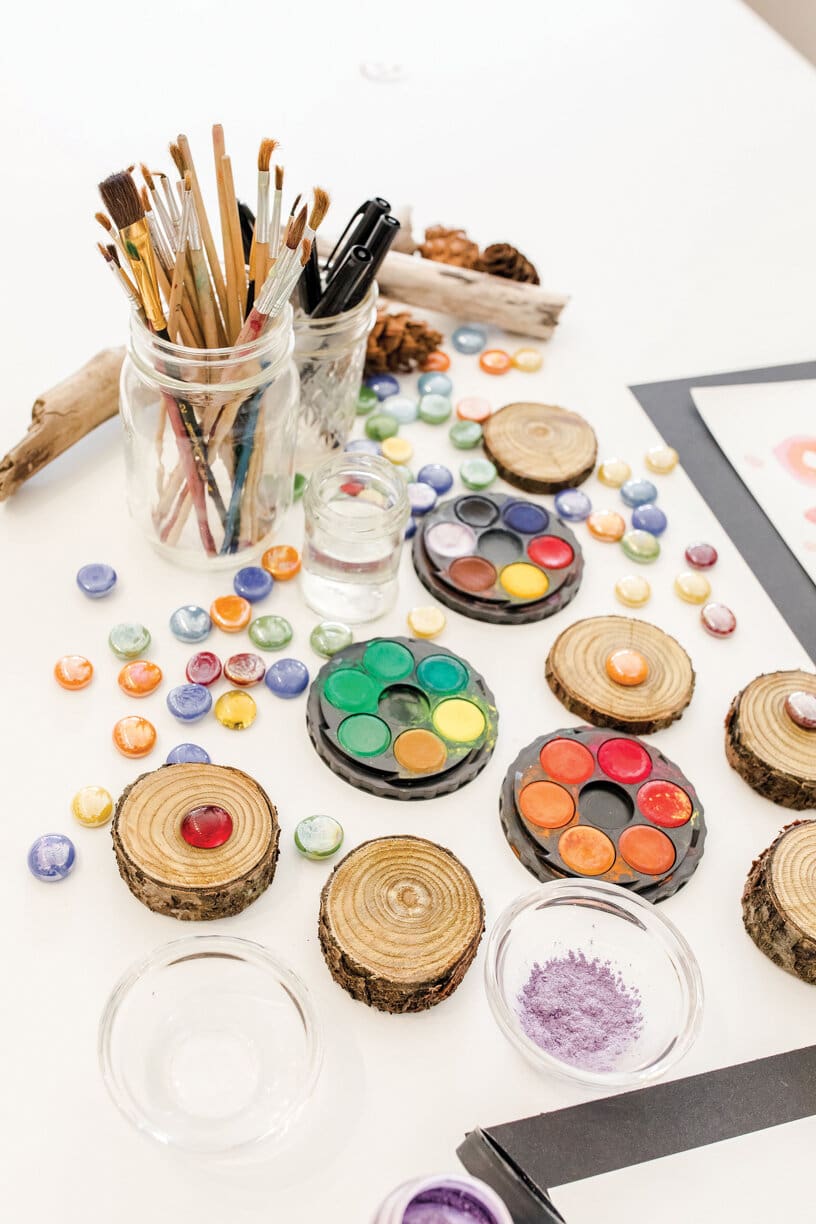
A teacher does not need a beautifully stocked studio to experiment with this. In fact, I would begin with whatever is already available. Choose one concept already alive in your curriculum—perhaps Character, Interdependence, Justice, Systems, Perspective, Migration, Balance, or something entirely different—and place the word in the middle of a table alongside a modest collection of ordinary things. String, stones, paper clips, cardboard, blocks, fabric scraps, elastic bands, buttons, sticks, wire, containers, and recycled materials are more than enough.
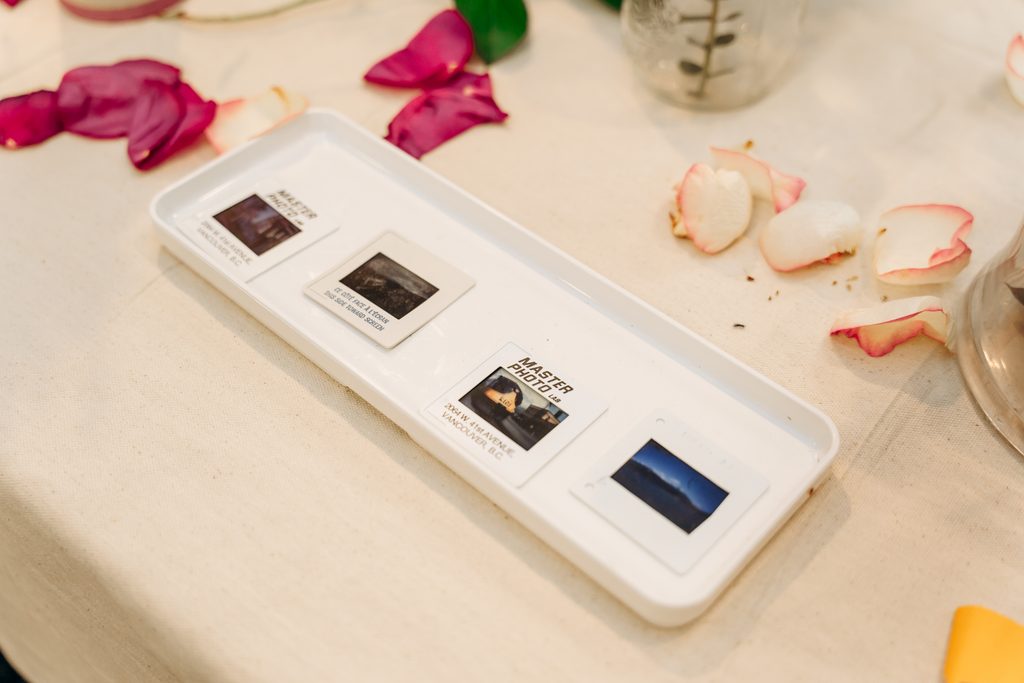
Rather than asking students to make a model of a concept, invite them to explore the conceptual qualities that emerge through their intra-actions with materials. Philosopher Karen Barad (2007) coined the term intra-action to describe how people, materials, and meanings do not simply interact as separate entities, but come into being and take shape through their relationships. A point of caution: A predetermined product can quickly turn the materials back into supplies for executing an idea. An invitation to explore characteristics, attributes, and qualities gives learners room to discover what the materials might contribute to their thinking.
As learners begin arranging, connecting, balancing, layering, separating, enclosing, dismantling, or transforming what is available, I am interested in the conversation that develops around the making. I might ask, What relationship are you exploring here? What is this material allowing you to think about? Where does your analogy stop working? What changes if you move this? What are you reconsidering after hearing someone else’s interpretation? Sometimes the most useful invitation is simply, Tell me about this.
The aim is not for the teacher to decipher what an arrangement “means” from across the room, nor is it to evaluate the aesthetic quality of the finished construction. Meaning develops through the relationship among the learner, the materials, the concept, and the conversations unfolding around them. What interests me most is often not what remains on the table at the end, but what changed in the learner’s thinking while making it.
Want to continue this inquiry with me?
The relationship among concepts, materials, and experiences sits at the heart of my Pop-Up Studio approach. It also informs the following workshops: Making Is Thinking, Creating to Think, and Thinking Through Analogy where educators investigate how materials and multiple forms of representation can participate in the development of increasingly sophisticated ideas. If these topics connect with questions you’re exploring in your own learning community, I’d love to bring Pop-Up Studio or one of these workshops to you and your team.
References
Barad, K. (2007). Meeting the universe halfway: Quantum physics and the entanglement of matter and meaning. Duke University Press.
Gibson, J. J. (1977). The theory of affordances. In R. Shaw & J. Bransford (Eds.), Perceiving, acting, and knowing: Toward an ecological psychology (pp. 67–82). Lawrence Erlbaum Associates.
Orbach, Nona. (2006). ON MATERIALS IN ART & ART THERAPY – ESSAY.
Pacini-Ketchabaw, V., Kind, S., & Kocher, L. L. M. (2017). Encounters with materials in early childhood education. Routledge.
Paterson, M. A. (2010). Living inquiry as pedagogy [Master’s thesis, University of British Columbia]. UBC Open Collections.
Pucci, R (2026). The grammar of matter archives – page 2 of 2 -https://www.robertapuccilab.com/category/the-grammar-of-matter/page/2/

Bring creativity, connection, and joy to the books you read together. My free Hosting Kit turns professional reading into a fun, participatory experience—inviting colleagues to play with ideas, make meaningful connections, and put new thinking into practice.
